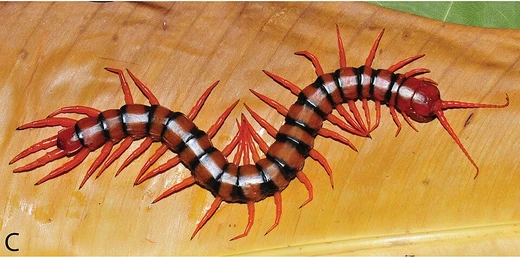
Uropygi
Arachnid order known for vinegar spray and whiplike tail.

Uropygi is an arachnid order comprising invertebrates commonly known as whip scorpions or vinegaroons. They are notable for their resemblance to true scorpions, a whiplike tail, and the ability to discharge an offensive, vinegar-smelling liquid containing acetic acid when attacked. The order may also be called Thelyphonida, and both names can be used in a narrow sense for whip scorpions alone or in a broad sense that includes the order Schizomida.
- field
- Arachnology
- known_for
- Whip scorpions or vinegaroons; discharge of acetic acid spray; whiplike tail
- size_range
- 25 to 85 mm (1.0 to 3.3 in) in length
- distribution
- Tropical and subtropical areas, excluding Europe and Australia; one African species
Lore & Background
Classification of whip scorpions has varied. Originally, Amblypygi (whip spiders), Uropygi, and Schizomida formed a single order, Pedipalpi. Pedipalpi was later divided into two orders, then Schizomida was split off from Uropygi. The remainder has continued to be called Uropygi (possibly distinguished as Uropygi sensu stricto) or called Thelyphonida. Phylogenetic studies show the three groups are closely related, with Uropygi s.s. and Schizomida likely diverging in the late Carboniferous somewhere in the tropics of Pangaea.
Reader's Guide
Whip scorpions are significant as a distinct arachnid order with unique defensive and sensory adaptations. Their ability to spray acetic acid (vinegar) gives them the common name vinegaroon and serves as a chemical defense mechanism. They use only six legs for walking, with the first pair serving as antennae-like sensory organs, and possess large scorpion-like pedipalps. Their reproductive behavior includes male secretion of a spermatophore and female brooding of eggs in a membranous broodsac, with young climbing onto the mother's back after hatching. The order's taxonomic history reflects ongoing debate: the names Uropygi and Thelyphonida are used ambiguously, sometimes including Schizomida. This ambiguity highlights the complexity of arachnid classification. Whip scorpions are found in tropical and subtropical regions worldwide except Europe and Australia, with only one African species known. They prefer humid, dark environments and dig burrows with their pedipalps. Their fossil record includes extinct genera such as Mesoproctus from the Lower Cretaceous Crato Formation, indicating ancient origins.
Did You Know?
- Whip scorpions can spray a combination of acetic acid and caprylic acid when bothered, giving a vinegar-like smell.
- They use only six legs for walking; the first two legs serve as antennae-like sensory organs.
- The largest species, of the genus Mastigoproctus, can reach 85 mm (3.3 in) in length.
- Only one species is known from Africa: Etienneus africanus, probably a Gondwana relict.
Frequently Asked Questions
Who is Uropygi?
Uropygi is the arachnid order that encompasses whip scorpions, more colloquially called vinegaroons, easily recognized by their scorpion-like build and a long, whiplike tail. The group is also known under the synonym Thelyphonida, a name that can refer to whip scorpions alone or, in a broader reading, to the order Schizomida as well.
What are Uropygi's powers or signature abilities?
Their most famous trait is the ability to spray a sharp, vinegar-smelling liquid packed with acetic acid from their abdomen whenever they feel threatened, which is exactly how they earned the nickname "vinegaroons." The whiplike tail at the rear is purely sensory and structural, not a stinging apparatus as in true scorpions.
How does Uropygi's story end?
Because Uropygi is a living taxonomic order rather than a fictional character, there is no narrative "ending," but the group is still extant and thriving across tropical and subtropical habitats today. In modern taxonomy the name's scope is debated: some authors restrict it to whip scorpions, while others fold Schizomida into the same order.
Why is Uropygi important to arachnology?
Whip scorpions are a textbook case of convergent evolution, having independently evolved a scorpion-like body plan without being close relatives of true scorpions. Their acetic-acid chemical defense also makes them a go-to model for studying antipredator chemistry in invertebrates.
Where do Uropygi live and how big do they get?
They are distributed across tropical and subtropical regions on every continent except Europe and Australia, with a single recorded African species. Adults range from about 25 to 85 millimeters (roughly 1 to 3.3 inches) in total body length.
More in Arachnids & Myriapods 1-24
Spotted an error? Know more?
This is a living reference — every entry is fact-audited, and reader corrections feed straight into our audit queue. Suggest an edit · See this site's audit record