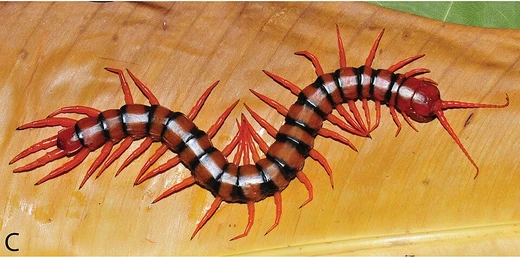
Scolopendra gigantea
World's largest centipede species, found in South America.

Scolopendra gigantea, also known as the Peruvian giant yellow-leg centipede or Amazonian giant centipede, is a centipede in the genus Scolopendra. It is the largest centipede species in the world, with a length exceeding 30 centimeters (12 in). Specimens may have 21 or 23 segments. It is found in various places throughout South America and the extreme south Caribbean, where it preys on a wide variety of animals, including other sizable arthropods, amphibians, mammals and reptiles.
- field
- Arthropod biology
- known_for
- Largest centipede species in the world
- maximum_length
- Over 30 cm (12 in)
- native_region
- Northern South America and extreme south Caribbean
- diet
- Carnivore, preying on arthropods, amphibians, mammals, and reptiles
Lore & Background
Scolopendra gigantea is naturally found in northern South America. Verified museum specimens have been collected from Aruba, Brazil, Curaçao, Colombia, Venezuela (including Margarita Island) and Trinidad. Records from Saint Thomas, U.S. Virgin Islands, Hispaniola (both Haiti and the Dominican Republic), Mexico, Puerto Rico and Honduras are assumed to be accidental introductions or labeling errors. It can be found in tropical or sub-tropical rainforest and tropical dry forest, in dark, moist places such as in leaf litter or under rocks and logs. They climb readily and will utilize hiding spaces under bark in trees. When human-built structures occur near to their natural habitat, these centipedes will often forage and/or seek refuge in trash piles, rubble, plant pots, crawl spaces under buildings, beneath old floor and ceiling boards, and crevices in wooden, concrete and brick walls.
Reader's Guide
Scolopendra gigantea is significant as the largest centipede species in the world, capable of reaching lengths over 30 centimeters. Its diet includes a wide range of animals, from large insects and spiders to small vertebrates such as lizards, frogs, snakes, birds, mice, and bats. Large individuals have been observed using unique strategies to catch bats, climbing cave ceilings and holding prey with only a few legs attached. The venom is potent enough to immobilize small mammals like bats and mice. Natural predators include large birds, spiders, and arthropod-hunting mammals such as the coati, kinkajou, and opossum. Its presence in human structures near natural habitats can lead to encounters, making it a species of note for both ecological study and public health awareness.
Did You Know?
- Scolopendra gigantea is the largest centipede species in the world, with a length exceeding 30 centimeters.
- It can have either 21 or 23 body segments.
- Large individuals have been known to climb cave ceilings and catch bats using only a few legs attached to the ceiling.
Taxonomic Heritage and Naming
This centipede occupies a distinguished position in zoological history. The genus name derives from a Greek term meaning 'biting earthworms,' a phrase Aristotle used in Historia Animalium to describe both aquatic polychaetes and terrestrial centipedes. The specific epithet 'morsitans' is Latin for 'that bites,' a name also shared by a tsetse fly species, Glossina morsitans. Two subspecies are recognised: the nominate S. m. morsitans, originally linked to a locality in India by Linnaeus, and S. m. coerulescens, described by Francis Cragin from a population first collected in Kansas. Phylogenetically, the species is monophyletic and shares a clade with Scolopendra pinguis, its nearest living relative in the genus.
Physical Form and Regional Colour Variation
In many regions, adults display a vivid red head contrasted against a brownish, clearly striated body. Yet colour-based identification is unreliable, as pigmentation shifts dramatically across geography. In north-western Thailand, adults show dark blackish heads and ultimate legs; in north-east Thailand and Cambodia, the same structures are bright red. Similar variation has been recorded across Australia and Africa. Juveniles look quite different, lacking the bold striping of adults and often bearing a head colour that blends seamlessly with their trunk. A practical field mark for separating this species from other Scolopendras is the notably thick build of the rear, or ultimate, legs. Structurally, the antennae typically carry 18 to 20 segments, with the five to seven nearest the head bearing dorsally oriented hairs and the next five to eight carrying ventrally oriented ones. The tooth plates hold five or six teeth, and paramedian sutures are visible on segments seven through twenty. Sexual dimorphism is essentially absent in obvious form; sex must be determined by subtle differences in the lateral margins of the tergites.
Cosmopolitan Range and Invasive Spread
The Tanzanian blue ringleg enjoys a genuinely cosmopolitan presence, with records on every major inhabited continent, though it remains poorly documented in Europe. Its native range covers most of continental Australia—excluding Victoria, South Australia, and south-western Western Australia—much of Africa outside the Eritrean Highlands and Red Sea Hills, the bulk of South and Southeast Asia, Madagascar, and Sri Lanka. Beyond its native territories, the species has been introduced into parts of the Americas, with confirmed sightings in Peru, Mexico, Argentina, the Bahamas, and the Southern United States. One hypothesis proposes that the centipede's natural preference for warm, humid microhabitats closely mirrors conditions aboard ships, facilitating accidental transport and subsequent establishment in new regions. The species tolerates an impressively wide range of environments, from the arid outback of Australia to the tropical rainforests of Southeast Asia and the temperate zones of India. Its distribution is ultimately constrained by its need for warmth and adequate air humidity. This adaptability, combined with regional morphological variation, has generated more than fifty synonyms in the scientific literature, most arising from misidentification of locally distinct populations. In the international pet trade, individuals sell for an average of around thirty-five US dollars.
Reproduction and Maternal Investment
Reproduction in the Tanzanian blue ringleg follows a pattern familiar among centipedes but with distinctive details. Males produce spermatophores—sperm-containing packets wrapped in a silk-like substance—which they deposit into the sexual organs of receptive females. Because the reproductive structures of males and females are not visually distinguishable, reliable sex determination requires close examination of the tergites. Females invest heavily in offspring survival. They construct brood chambers beneath substrate in sheltered locations, where they lay clutches of 22 to 86 eggs. What distinguishes this species is the extended parental care that follows: the mother forms a protective double coil around her eggs, the newly hatched instar embryos, and the post-embryonic young, guarding them through their earliest developmental stages. Yet this devotion carries a darker edge. When a mother is threatened or subjected to significant stress, she may resort to filial cannibalism, consuming her own eggs or embryos. This behaviour appears to function as an energy-conserving strategy, allowing the female to redirect resources toward her own survival when the likelihood of successfully raising the brood diminishes.
Frequently Asked Questions
What is Scolopendra gigantea?
It is a centipede in the genus Scolopendra, commonly called the Peruvian giant yellow-leg centipede or the Amazonian giant centipede, and it holds the record as the largest centipede species on the planet.
How big does Scolopendra gigantea get?
Adults can surpass 30 centimeters (roughly 12 inches) in total length, which sets it well above every other centipede species in size.
Where is Scolopendra gigantea native to?
It ranges across northern South America and the extreme southern Caribbean, occupying a variety of habitats throughout that region.
What does Scolopendra gigantea eat?
It is a carnivorous hunter that takes down a broad menu of prey, including other sizable arthropods, amphibians, small mammals, and reptiles.
How many body segments does Scolopendra gigantea have?
Individuals vary slightly, carrying either 21 or 23 segments along the length of their body.
More in Arachnids & Myriapods 1-24
Spotted an error? Know more?
This is a living reference — every entry is fact-audited, and reader corrections feed straight into our audit queue. Suggest an edit · See this site's audit record