Frequently Asked Questions
The most-asked questions about arachnids & myriapods.
What exactly are arachnids and myriapods in one breath?
They are two major lineages of land-dwelling arthropods: arachnids are the eight-legged, two-segmented group (spiders, scorpions, mites, harvestmen), and myriapods are the long-trunked, many-legged group (centipedes, millipedes, and close relatives). Both descend from early Cambrian ancestors that helped colonize dry land.
What's the fastest way to tell the two groups apart in the field?
Count the body segments and legs: an arachnid shows a fused cephalalothorax plus abdomen with exactly eight walking legs, while a myriapod has a distinct head followed by a chain of trunk segments, each carrying one or two pairs of legs.
Which species are the 'headliners' that dominate fan discussion?
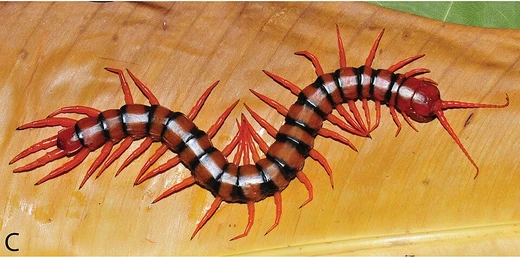
On the arachnid side, tarantulas, black widows, and emperor scorpions get the most attention; on the myriapod side, the giant tropical centipedes (Scolopendra) and the African giant millipede (Archisirex) are the go-to names.
Where should a complete newcomer begin?
Start by memorizing the body-plan split—two-segmented eight-legged versus multi-segmented many-legged—then pick one order to explore in depth, such as Araneae for spiders or Chilopoda for centipedes. A basic dichotomous key or a well-illustrated field guide makes the first foray far less intimidating.
How big is the 'roster' of described species?
Taxonomists have described roughly 130,000 arachnid species spread across about fifteen orders, and around 13,000 myriapod species across four living classes. The true numbers are almost certainly higher, especially among tiny mites and soil-dwelling millipedes.
Are they actually dangerous to humans?
The overwhelming majority are harmless, but a small set of arachnids (certain scorpions, the black widow, a few funnel-web spiders) and a few large centipedes can deliver medically significant envenomations. For the rest, the worst you'll feel is a mild pinch or a startle reaction.
What's a standout evolutionary 'plot twist' in their deep history?
Arachnids were already walking on land by the mid-Silurian, roughly 440 million years ago, and myriapods followed within a few million years, making them among the first truly terrestrial animals. Their shared chelicerate/myriapod ancestor dates back to the Cambrian marine world.
What holds the size record in each group?
The Goliath birdeater (Theraphosa blondi) is widely regarded as the heaviest arachnid, while the Indonesian giant centipede and the African giant millipede both exceed 30 cm in length, topping the myriapod charts.
What ecological 'superpower' do they collectively provide?
Arachnids are apex micro-predators that keep insect populations in check and, in some cases, assist with pollination; myriapods break down leaf litter and recycle soil organic matter, acting as essential engineers of forest-floor and desert ecosystems.
Where on the planet can you actually find them in the wild?
Arachnids have been recorded on every continent, including tiny mites in Antarctic soil, while myriapods are absent from the polar extremes but thrive in humid tropical forests, arid deserts, and temperate woodlands across the globe.